
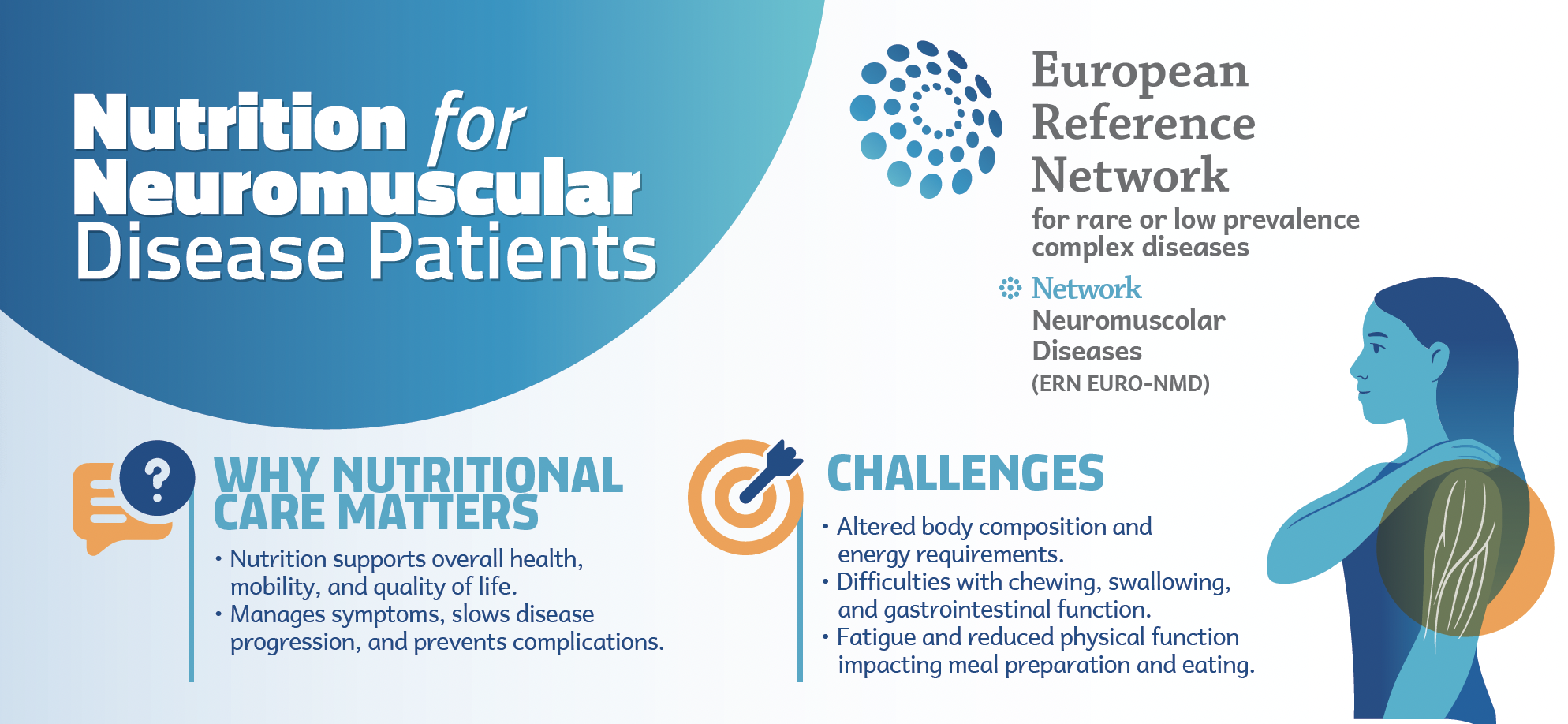
Nutrition plays a vital role in the care of individuals with neuromuscular diseases (NMDs). This flyer highlights the importance of regular nutritional assessment and offers practical strategies to manage common challenges, improve quality of life, and support multidisciplinary care.
The flyer uploaded below provides a concise yet comprehensive overview of the critical role nutrition plays in managing neuromuscular diseases (NMDs).
It outlines:
-
Why nutritional care is essential: Explaining how proper nutrition supports health, mobility, symptom management, and quality of life for people living with NMDs.
-
Key nutritional challenges: Including difficulties with chewing, swallowing, digestion, and changes in energy needs or body composition.
-
Assessment and monitoring: Recommending regular screening for dysphagia, weight monitoring, and relevant blood tests to track nutritional status.
-
Personalized management strategies: Offering practical guidance for addressing undernutrition, poor appetite, and overweight.
-
Specific concerns: Including how to manage metabolic comorbidities and gastrointestinal symptoms through tailored dietary approaches.
-
The value of coordinated care: Emphasizing the importance of open communication and collaboration between patients, caregivers, and multidisciplinary healthcare teams to ensure effective and individualized nutritional support.
Available translations
Portuguese
Italian
Polish
Spanish
Dannish
Contribution to the Translation of the Nutrition Flyer for NMDs into Multiple Languages
Coordination and assistance with translations
Manuela Lavorato, PhD
WP7 ERN EURO-NMD Project manager, U.O. Neurology, University Hospital of Pisa (Italy)
Dr. Marianne Nordstrøm, Clinical dietitian, Ph.d
National Centre for Rare Diseases, Unit Frambu and Unit for Inborn and Hereditary Neuromuscular Disorders, Department of Neurology, Oslo University Hospital
Spanish version
Dr. Marcello Bellusci, Metabolic peditrician and HCP representative
Hospital Universitario 12 de Octubre, Madrid – Spain
Erika Maria Fernandez-Vizarra
1 Department of Biochemistry and Molecular and Cellular Biology, Faculty of Health and Sport Sciences, University of Zaragoza, Huesca 22002, Spain
2 Aragon Healthcare Research Institute (IIS-Aragón), Zaragoza 50009, Spain
3 Centro de Investigaciones Biomédicas en Red de Enfermedades Raras (CIBERER), Instituto de Salud Carlos III (ISCIII), Madrid 28029, Spain
Portuguese version
Dr. Andreia Rocha, Physiotherapist
Unidade Local de Saúde Santo António (USSLA – Porto – Portugal) to António (ULSSA – Porto – Portugal)
João Miguel Alves Ferreira
¹Institute of Pharmacology and Experimental Therapeutics, Faculty of Medicine, University of Coimbra, 3004-531 Coimbra, Portugal
²Coimbra Institute for Clinical and Biomedical Research (iCBR), Faculty of Medicine, University of Coimbra, 3004-531 Coimbra, Portugal
³Center for Innovative Biomedicine and Biotechnology (CIBB), University of Coimbra, 3004-531 Coimbra, Portugal
Italian version
Dr. Davide Pareyson, MD, clinical Neurologist
Fondazione IRCCS Istituto Neurologico C.Besta (FINCB)
Filippo Genovese, PhD, Scientific Coordinator / International Relations /SMM
ACMT-Rete per la malattia di Charcot-Marie-Tooth OdV
Polish version
Karolina Suszyńska
The Polish Charcot-Marie-Tooth Association (cmtp.pl)
French version
Manuela Lavorato, PhD
WP7 ERN EURO-NMD Project manager, U.O. Neurology, University Hospital of Pisa (Italy)
Elisabeth Avidi Muelle
EURO-NMD Communication Manager