
15 Jul 2026
Home > Publications > Review >
Advancing the diagnosis of rare neuromuscular and neurological diseases through the collaborative Solve-RD research framework
Authors:
Lisa-Sophie Wüstner, Kornelia Ellwanger, Nika Schuermans, German Demidov, Kiran Polavarapu, Leslie Matalonga, Steven Laurie, Solve-RD DITF-RND, Solve-RD DITF-EURO-NMD, Ana Töpf, Katja Lohmann, Holm Graessner.
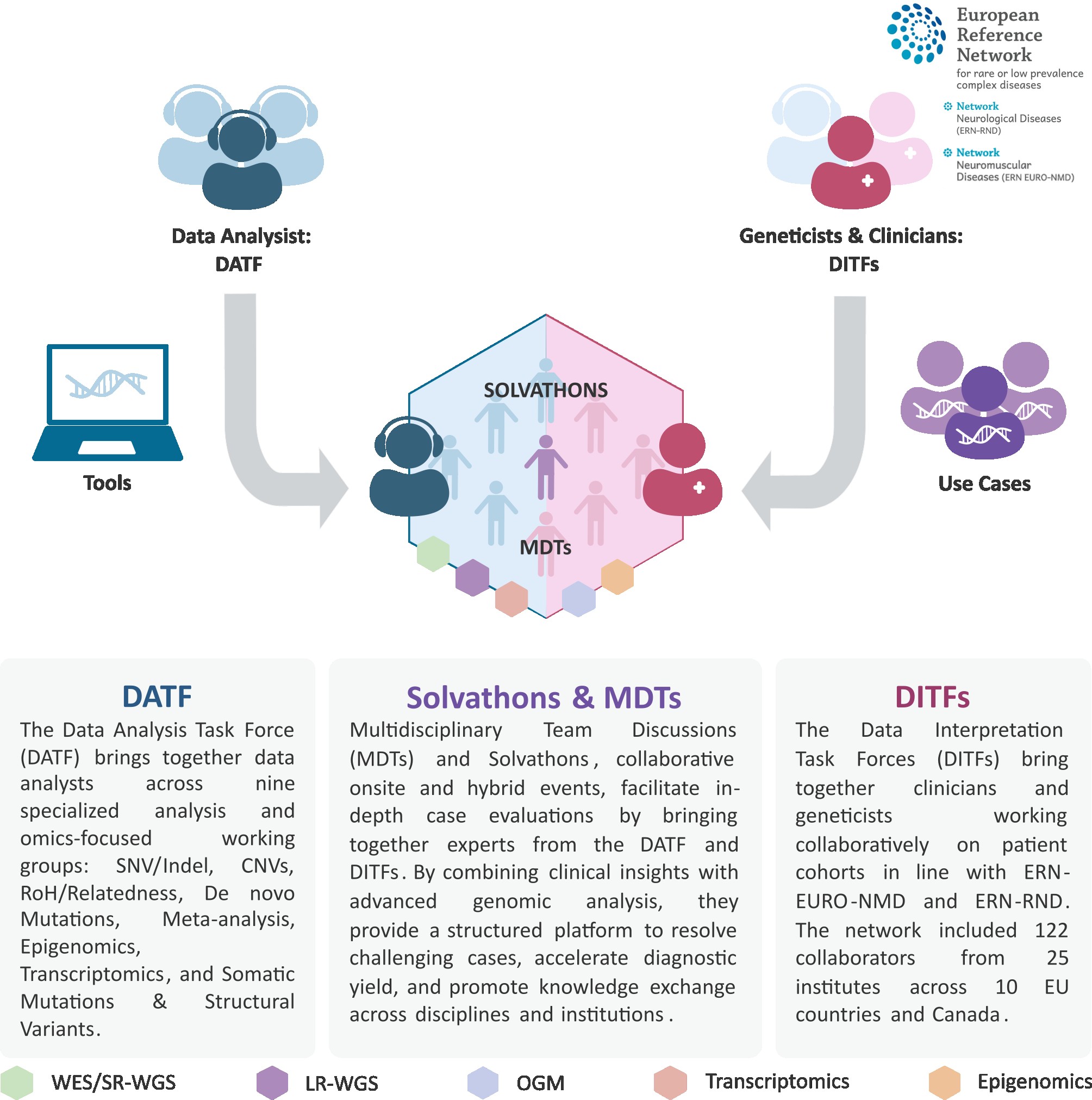
Rare neuromuscular and neurological diseases (NMDs and RNDs) present diagnostic challenges due to their clinical heterogeneity and genetic complexity. Despite the advancements in next-generation sequencing (NGS) and other high-throughput genomic technologies, a significant proportion of patients with NMDs and RNDs remain undiagnosed. This is primarily due to genetic heterogeneity, the presence of novel or private variants, and incomplete variant detection by short-read sequencing platforms. The Solve-RD project, a pan-European initiative funded by the Horizon 2020 programme, established a robust interdisciplinary framework integrating expert clinical and bioinformatics teams through Data Interpretation Task Forces (DITFs) and Data Analysis Task Force (DATF). Focusing on previously undiagnosed NMD and RND patients, Solve-RD implemented a systematic reanalysis of exome/genome data. For specific cohorts, various omics approaches were added, including long-read genome sequencing, RNA sequencing, and optical genome mapping. This collaborative framework significantly improved diagnostic yield in RND and NMD cohorts and led to the identification of novel pathogenic variants and mechanisms. The Solve-RD model exemplifies how structured expert collaboration, data sharing and harmonisation, and cutting-edge multi-omics technologies can overcome current diagnostic limitations in rare disease research.